

The Freaky Link Journal · BDSM for Beginners
You do not need a dungeon to be curious about BDSM. You do need a conversation. Conveniently, the conversation costs considerably less than redecorating.
If you have been wondering where to start, I would put shopping second. First comes working out what interests you, what your partner is interested in, and what is firmly off the menu.
This guide to BDSM for beginners is about taking that first step thoughtfully. Curiosity can stay small. A blindfold, a change of roles or simply talking about a fantasy can be plenty.
First, what does BDSM mean?
BDSM is an umbrella term covering bondage and discipline, dominance and submission, and sadism and masochism. People may be interested in one part, several parts or none of the labels. You do not have to collect the complete set.
For some adults, the appeal is sensation. For others, it is anticipation, a role they have agreed to explore, or a temporary exchange of control. The useful question is “Which part interests us?” rather than “How far are we supposed to go?”
Have the conversation while everyone can think clearly
I would choose a relaxed moment outside sexual activity. Try: “I am curious about a blindfold. Does that sound interesting to you, or would you rather leave it as a fantasy?” Specific questions are much easier to answer than “Are you kinky?”
Agree what you might do, the intensity, what you will avoid and how you will stop. Discuss relevant injuries, health conditions, sensitivities and worries. Consent needs to be freely given, informed and ongoing. Buying a kit, having tried something before or being in a relationship does not create permission.
The National Coalition for Sexual Freedom’s consent guidance emphasizes agreeing specific activities in advance and having a clear way to stop. You should be able to make those decisions without intoxication or pressure.
Make stopping ridiculously easy
Agree a safeword or signal beforehand. A traffic-light system is one option: green means okay, yellow means pause or reduce intensity, and red means stop. Decide what each word means to both of you. Ordinary “no” and “stop” still count.
If speaking could be difficult, agree a clear non-verbal signal and make sure it is usable. For a first exploration, keep speech and movement available. Silence, freezing or looking uncomfortable are reasons to pause and check in, even if no safeword has been used.
Keep the first experiment simple
Pick one idea rather than debuting a twelve-piece kit in a single evening. You might discuss a blindfold, take turns choosing the music or explore the feeling of soft fabric against the skin. Decide what you are doing and how long you want to try it, then check in.
If you are considering restraints, learn their correct use before trying them. Choose purpose-made equipment with an easy release, read its instructions and keep the release immediately available. Never leave a restrained person alone. Stop and release immediately for numbness, tingling, unusual colour, pain or distress.
I would leave rope techniques, suspension, breath restriction and neck pressure out of a beginner experiment. A blog post cannot teach the skills or remove the risks involved. More equipment is not a substitute for training.
Aftercare is a question you ask, not a script you follow
Afterwards, ask what each person would like. That could be water, a blanket, quiet time, reassurance or a cuddle. Some people want space. The kind thing is to ask rather than assume.
Check in again later: what felt good, what felt awkward and what would you change? You may want to repeat something, alter it or put it firmly in the “interesting, but no thanks” folder. Every one of those outcomes is useful.
Buy for the idea you have actually agreed to
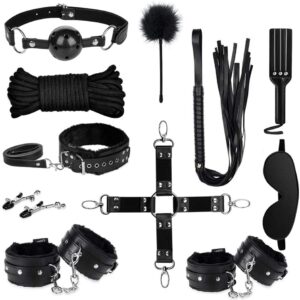
When you are ready to browse, look for clear materials, sizing, release mechanisms and care instructions. The products below are three related options from our catalogue. A larger kit offers more items, but it also means more instructions to understand. Open each listing and ask us about anything the description does not settle.
My preference for a first shopping list is short: one agreed idea, suitable equipment if needed, and enough time to talk. A shopping basket full of confidence is still not consent.
The related edit
A few things worth a look
Three products connected to this conversation. Open each page for the details, current price and availability.


Let’s talk practical details
Questions about sizing or what is included in a kit? Ask us before ordering. For personal health concerns or specialist techniques, seek qualified advice or practical training.
Ask us on WhatsAppBy The Freaky Link editorial team · Updated 15 October 2026. General information for adults. The Freaky Link sells the products featured here. Illustrative editorial imagery.
